I Signed Up for a Marathon Last Minute — Here’s How It Went
Most people spend months preparing for a marathon — following structured plans, stacking long runs, and tapering carefully before race day. None of which I had done when I spontaneously decided to run the Toronto Waterfront Marathon with just three days’ notice.
It wasn’t on my calendar, I hadn’t done a marathon-specific training block, and I definitely wasn’t tapered — although I was confident in my fitness, feeling strong, and curious about how well I could do. Plus, this is a race I’ve always wanted to run, so once I got the idea in my head, I decided to just go for it.
So here’s what happened when I signed up for a marathon last minute, how it went, and what I learned along the way.
The Ordinary Athlete contains affiliate links and is a member of the Amazon Services LLC Associates Program. If you make a purchase using one of these links, we may receive compensation at no extra cost to you. We only recommend products and services we use and trust. Read our disclaimer for more information.
Why I Decided to Run a Marathon Last Minute
Firstly, it’s worth noting that signing up for a marathon last minute is not something I would normally do — or recommend. Running a marathon is no small feat; it can take a significant toll on your body, and going in unprepared can put you at risk of injury.
However, this wasn’t my first marathon, and I wasn’t completely untrained. I had completed an Ironman a couple of months ago, was feeling fully recovered, and had resumed triathlon training while deciding what my next race should be. But I definitely hadn’t followed a marathon plan, done a taper, or even planned to race. It was a true last-minute decision.
Anyone who knows me knows I love a challenge — and I was genuinely curious to see how far my general fitness could take me. It started as a passing thought, and before I knew it, I was browsing Strava community groups for last-minute bib transfers (since the event was sold out). I found one within a couple of hours and officially registered on Thursday for the race on Sunday.
There wasn’t enough time to stress about it or overthink it. I told myself to treat it like a long group training run (with a few thousand people!). I wasn’t chasing a PR — or so I told myself. This was meant to be a fun experiment: a test of endurance, mindset, and experience. My main goals were to pace smart, listen to my body, and enjoy the day.
My “Training” (or Lack Of)
To be clear, I wasn’t heading into the marathon off the couch. My ongoing triathlon training had me running three times per week, averaging around 35 km (22 miles), with one weekly long run of about two hours. On top of that, I was doing two swims and three bike sessions per week, including a long ride between 4–5 hours.
So while I wasn’t marathon-ready, I did have a solid aerobic base.
What I didn’t have was a taper or marathon-specific preparation. My weekly running volume was well below what’s typical for marathon training, and my longest run leading up to the race was just 24 km (15 miles) — completed only a few days earlier. My legs were also carrying fatigue from several tough threshold sessions on the bike, and the only real change I made was skipping my long ride the day before the race.
Overall, I was relying on cumulative fitness and my experience running on tired legs, rather than peak training and a strategic taper.
My Race-Day Strategy: Control What You Can
With only three days to go, the lack of training or taper was out of my control. So instead, I focused on doing everything else right: fuelling, pacing, and mindset.
Carb Loading
Once I decided to sign up, I immediately started carb loading to top up my glycogen stores, aiming for 400–600 g of carbs per day in the 72 hours before race day. That meant carb-heavy meals (oatmeal, pasta, rice) and plenty of snacks — candy, toast, and cereal between meals. Eating that much can actually be tough, so I also used juice, soda, and sports drinks and for easy calories, and made sure to stay well hydrated throughout the day.
Pacing
Pacing a marathon properly is crucial — you want to avoid going out too fast and bonking later on. The goal is to run as even a split between the first and second half as possible.
Because I hadn’t trained specifically for this race, I wasn’t sure what my goal pace should be. But I felt confident in my fitness and was determined to run under four hours. My marathon PR was 3:51:14, and even though I’d done less run-specific training this time, I believed I was fitter overall.
So I set an A goal of 3:45–3:50, a B goal of sub-4, and a C goal of simply finishing strong and having fun.
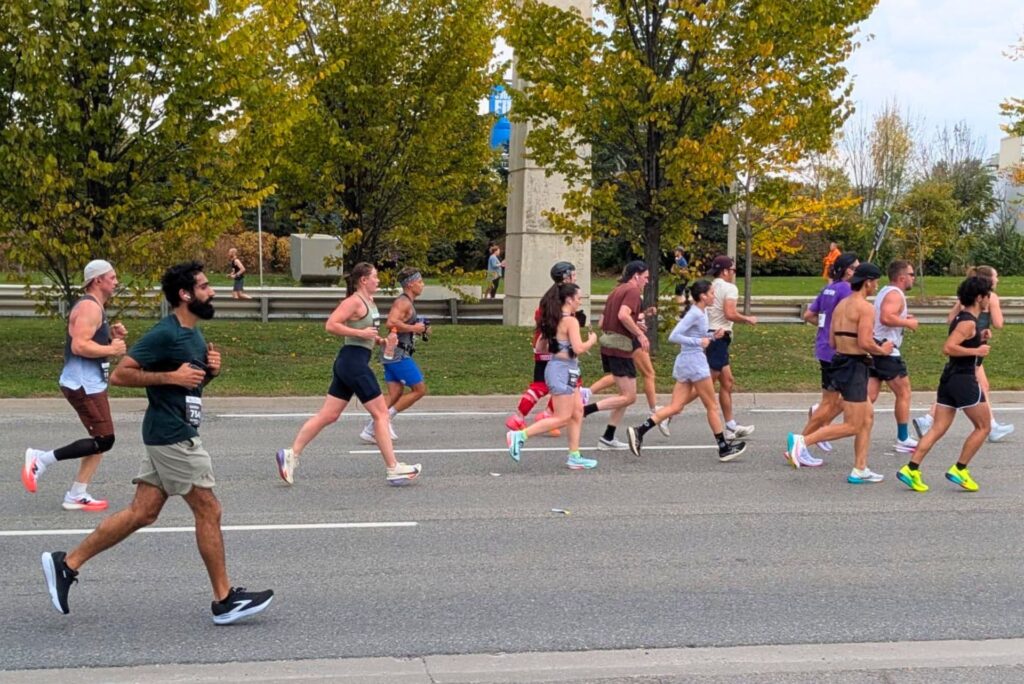
Fortunately, the marathon had pacers, so I decided the best approach was to stick with one. On race morning, I lined up in my corral, found the 3:50 pacer, and started with his group — staying with them for almost the entire race and only moving ahead in the final 2 km (1.2 miles). Not only did he set an ideal pace, but he was also upbeat and encouraging the entire way.
Fuelling
Although I hadn’t been practicing my fuelling strategy, I already knew what worked for me in long races. I stocked up on a mix of Maurten, Gu, and Brix energy gels, rotating flavours to avoid fatigue.
Fuelling was one of the few things I could fully control, so I wanted to execute it well. I aimed for roughly 50 g of carbs per hour — about one gel every 25 minutes — and ended up taking eight gels total. Fortunately, they all sat well in my stomach (though I was definitely sick of them by the end!).
Because it was a warm, humid day and I’m a salty sweater, I also took electrolyte tabs every 45 minutes and ran with a handheld water bottle so I could sip consistently instead of relying on aid-station cups. This helped me stay properly hydrated from start to finish.
Mindset
While deep down I wanted to do well, I tried to stay realistic. I decided to treat the marathon like a long training day — listening to my body and slowing down if needed. My main goal was simply to complete my long run for the week, only this time I’d get to do it with thousands of runners, an electric atmosphere, and a medal waiting at the finish line.
Keeping that mindset — and focusing only on what I could control — helped me start relaxed and confident. I knew I couldn’t fake a taper or mileage, but I could still run a smart, steady race.

How the Race Went
So, how did it go? Surprisingly well.
I managed to execute my plan almost perfectly: steady pacing, consistent fuelling, and a finishing time of 3:48:36 — almost a four-minute PR! Even more surprising was how comfortable I felt for most of the race.
I quickly settled into pace with the 3:50 group and stayed close to the pacer, occasionally drifting ahead or behind at water stations but always rejoining the pack. A small group of us ran together nearly the entire way.
The first half flew by. My heart rate stayed steady, my legs felt strong, and my effort felt controlled. Around 25 km (15.5 miles), my right hip started to ache — something that’s happened before — but it stayed manageable.
From 30 km (18.6 miles) onward, a few small inclines and false flats started to bite, but thanks to early and frequent fuelling, I never hit the wall. The final 5 km (3 miles) were tough as fatigue set in, but by then I knew I was on track for a PR, so I focused on holding pace — even managing to speed up slightly in the final mile.
While I felt surprisingly good throughout, I was very happy to see the finish line. Within seconds, though, my legs turned to concrete. Walking afterward was slow and comical, and the soreness lasted a couple of days — but that’s to be expected after a marathon.
Another pleasant surprise was how consistent my pacing was, with just a four-minute positive split. My heart rate also stayed remarkably steady in the lower end of Zone 3 for most of the race, only rising slightly right at the end.
What I Learned From Running a Marathon Without a Training Block
This race taught me more about my fitness and mindset than any structured plan ever could. Here’s what I learned:
Base fitness matters more than you think.
Years of endurance training builds resilience that doesn’t disappear. You don’t need massive mileage every week and consistent cross-training can build a strong aerobic base too.
The taper is important — but not everything.
I definitely felt some fatigue on race day, but smart pacing and fuelling got me through feeling strong. Execution mattered more than feeling fresh.
Mindset makes a huge difference.
One advantage of signing up last minute was that I didn’t have time to overthink or stress. By focusing only on what I could control and setting realistic expectations, I went into the race calm and ready to enjoy it.
Respect the distance.
Even with great fitness and experience, 42.2 km (26.2 miles) will always be a challenge. For me, my sore hip was a reminder that I need to keep prioritizing strength and mobility work.
I’m capable of more.
Running a PR in a marathon I hadn’t specifically prepared for showed me that my potential is higher than I realized. With a proper training block and taper, I’m confident I could run an even faster time.

Final Thoughts
Running a marathon last minute isn’t for everyone — and it’s not something I’d recommend often. But if you already have a solid fitness base, some long runs behind you, the right mindset, and realistic expectations, it’s absolutely possible to have a successful race.
Sometimes, the best races aren’t the ones you plan months in advance — they’re the ones that remind you what your body and mind are truly capable of.