Ironman Cozumel Race Report 2025 (+ What to Expect)
On November 23rd, 2025, I finished Ironman Cozumel. This was my second full-distance triathlon — and one I only signed up for three weeks in advance. While my preparation was far from perfect (and I faced a few race-day challenges), I ended up doing surprisingly well, learned a lot, and had an incredible time on the island.
Cozumel truly is a bucket-list race, and one I’d recommend to both first-timers and seasoned athletes chasing a PR. Here’s my full Ironman Cozumel race report, along with an overview of my time on the island and some practical tips if you’re considering this event.
The Ordinary Athlete contains affiliate links and is a member of the Amazon Services LLC Associates Program. If you make a purchase using one of these links, we may receive compensation at no extra cost to you. We only recommend products and services we use and trust. Read our disclaimer for more information.
Why Ironman Cozumel
Ironman Cozumel was never part of the plan. After finishing Ironman Ottawa in August, I didn’t expect to be lining up for another full-distance race three months later — but triathlon has a way of pulling you back in. My partner and I were already talking about “the next one” at the Ottawa finish line, so I knew it wasn’t going to be a one-and-done. I just didn’t realize the next one would be this soon.
When I began casually browsing races, Cozumel immediately caught my attention. The island is gorgeous, and the swim is famous for being one of the most beautiful in the Ironman circuit — crystal-clear water, a colourful reef, and marine life everywhere.
We had floated the idea of doing it this year, but it didn’t become a real plan until three weeks out, when we decided to just go for it. The weather in Toronto was getting miserable, we were craving sunshine, and the race timing aligned perfectly with a family vacation happening nearby. One week later, we were on a plane — bikes, bags, and a very loose training plan in tow.
Our preparation definitely wasn’t textbook. I had been loosely training since Ottawa (mostly because I didn’t know what to do with myself otherwise), but I had also squeezed in an unplanned marathon, skipped more bike sessions than I should have, and generally hadn’t been training with a full Ironman in mind. My partner had done even less.
But this race wasn’t meant to be about fast times. It was about having fun, testing what our bodies could do, and enjoying an active warm-weather escape — which is exactly what we did.

Where to Stay in Cozumel
Ironman Cozumel has several official host hotels that offer added perks for athletes, including on-site bike mechanics, shuttles to T1 on race morning, and discounted room rates. However, when I compared prices for next year, I actually found better deals for some of these hotels on sites like booking.com and hotels.com — so it’s worth shopping around.
According to the Ironman Accommodations page, the official host hotels for 2026 are:
- Iberostar Waves (all-inclusive)
- Coral Princess Hotel & Dive Resort (includes breakfast)
- Hotel B Cozumel and Hotel B Unique (adults only)
- The Explorean (all-inclusive)
- Casa del Mar Cozumel Hotel & Dive Resort
- Presidente InterContinental Resort & Spa
- Grand Park Royal (all-inclusive)
- Sunscape Sabor Cozumel (all-inclusive)
- Melia Cozumel (all-inclusive)
- The Westin Cozumel (all-inclusive)
Some of these properties are on the pricier side, but if you’re only staying for a few days, I can absolutely see the appeal of the convenience — especially the all-inclusives.
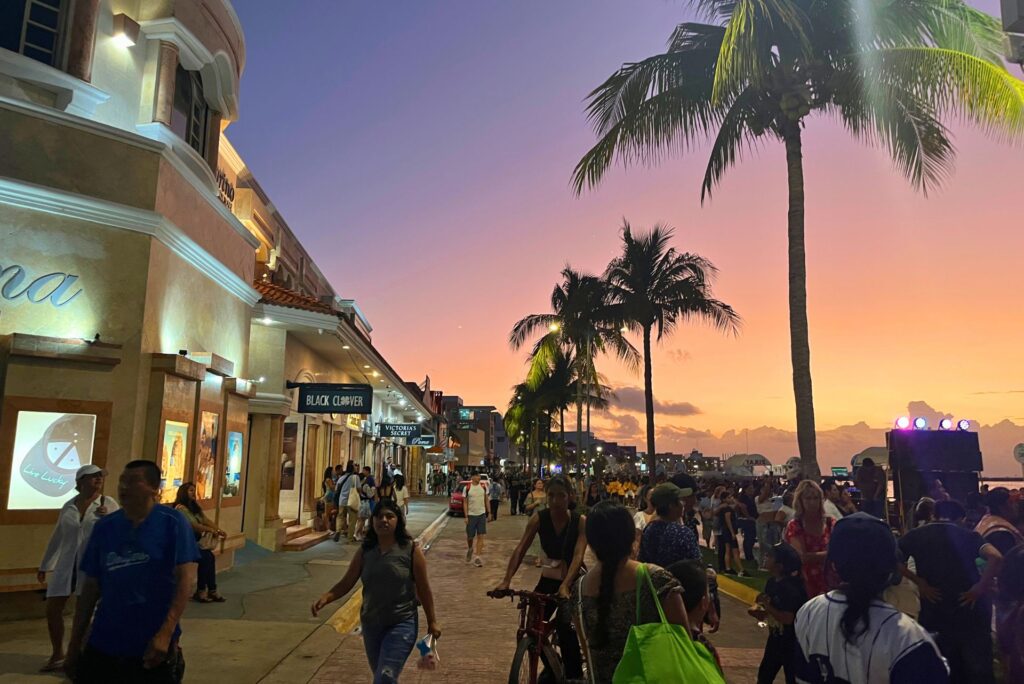
That said, Cozumel has plenty of other hotels and vacation rentals to fit every budget. If you choose a non-host hotel, I recommend staying in or near the town centre. You’ll have easy access to restaurants, supermarkets, taxis, the Ironman expo, and the finish line — all of which make race weekend much simpler.
For the best availability and price, booking early is ideal. But if you end up signing up last minute like we did, don’t panic — there were still plenty of options available!
We opted for a small B&B in a more local neighbourhood to keep costs down, since we were staying for over two weeks. It won’t be everyone’s style, but it suited us perfectly. We were close to a supermarket, local eateries, and a sports complex, and about 2 km from the main town — close enough to walk or take a tiki taxi (a far cheaper option than the regular taxis).
Pre-Race in Cozumel
Training & Tapering on the Island
We were eager to escape Toronto’s November weather, and since we both work remotely, we headed to Cozumel two weeks early to acclimatize and explore. If you have the ability to do this, I highly recommend it.
The first few days were a bit of a shock to the system. The heat hit hard — 30°C and high humidity makes even easy runs feel tough — but after training through multiple heat waves in Toronto this summer, my body adapted quickly. I just focused on staying hydrated and keeping up with electrolytes during those first few days, which helped enormously.
Open Water Swimming
Unfortunately, the Norte winds rolled in shortly after we arrived, making the ocean too rough to swim for most of the first week. When the water finally calmed, I managed a handful of swims in the warm, crystal-clear water.
I’d never swum a race without a wetsuit or in the ocean before, so I was slightly nervous — but the saltwater buoyancy really makes a difference. I instantly felt comfortable, loved being able to see so much marine life, and was surprised by how easy swimming felt.
The best spot we found to swim was Stingray Beach, a public waterfront area a couple of kilometres from the town centre that’s popular with both Ironman athletes and locals. The water here is beautiful, there’s tons of marine life to see, and the buoys make it easy to follow a straight line. There’s also a rope to help you get in (it’s a little rocky) and a few sandbags to step on, plus a small turf area where you can stand to adjust your gear. We had no issues leaving our belongings on the beach while we swam, though I wouldn’t recommend leaving anything valuable unattended.
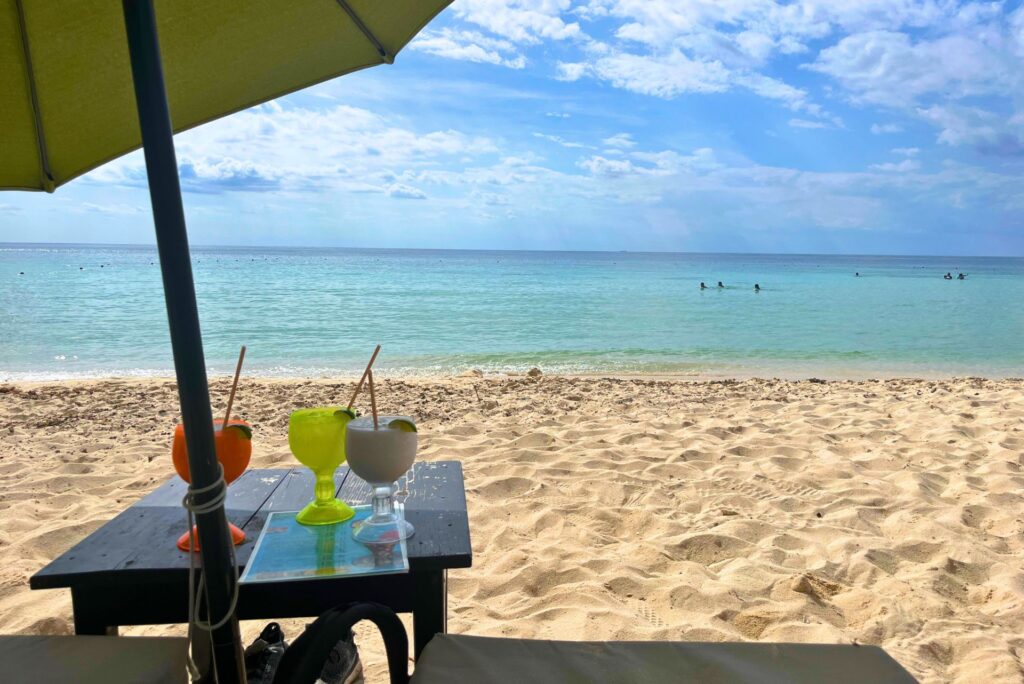
Most of the other decent open-water swimming spots on the island are attached to beach clubs. My favourites were Skyreef Beach Club (free entry and lots of marine life to see!) and Playa Palancar (a relaxed vibe and a beautiful beach).
Cycling Around the Island
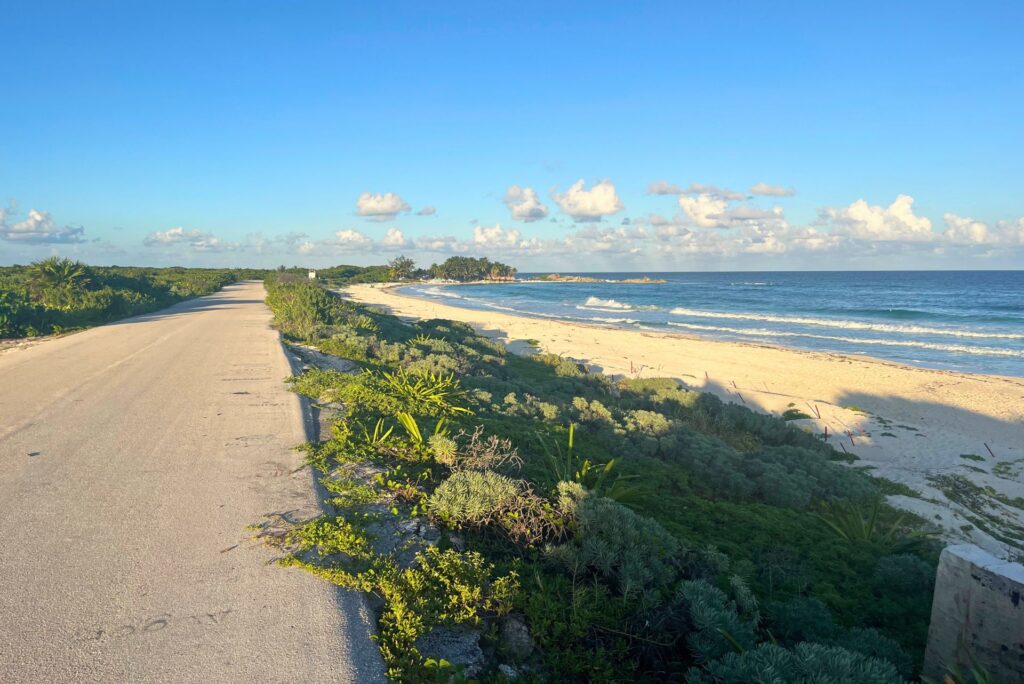
We got in a few good bike rides as well. Following tips from a local bike shop, we avoided the busy west side (full of beach clubs, hotels, and cruise traffic) and focused most of our rides on the east side instead.
The roads in Cozumel are surprisingly well maintained, with very few potholes or bumps, and once you get out of town there’s hardly any traffic. The road along the north-east stretch has a wide enough shoulder to ride on and flashing lights that activate in the late afternoon (just make sure you don’t clip one with your wheel!), which made it feel safe. The east and south sides have a secondary road that runs parallel to the main road — partly a bike path, but also occasionally used by small vehicles. But it’s virtually empty, and many cyclists prefer riding on the main road to pick up a bit more speed.
The east side is known for its brutal wind — which we definitely experienced. Riding out with the tailwind was always great fun, whereas riding back into the headwind really takes it out of you. But since this was the same wind we’d face on race day, it ended up being perfect last-minute training. The views on this side of the island are also spectacular. Just watch out for wildlife — we saw plenty of iguanas, birds, a snake, and, to our surprise, a wild pig.
Also make sure to pack plenty of water — you go through it quickly in the heat. And bring some cash, as there are a few beach bars along the route where you can restock (or stop to enjoy a cold drink).
Running in the Heat
For running, I alternated between the stretch north of the airport (part of the actual Ironman run course) and the local sports complexes. My favourite spot was Unidad Deportiva Independencia — a big facility with a track, floodlights at night, and plenty of locals training. There’s also a 25 m pool there, which I used early in the trip when the ocean was too rough.
Since we were technically in the taper period, I wasn’t doing particularly long sessions. But staying active in the heat, exploring new training spots, and getting comfortable with island conditions made a huge difference on race day.
Food & Cafés
Another thing we loved about Cozumel was the food. It’s a fantastic place to fuel — both before and after the race. As a tourist hub, the island has no shortage of bars, cafés, and restaurants. Many of the spots in the central area cater to tourists, so some are a little overpriced for what you get, but we still found several places we loved and kept going back to:
- La Choza — traditional Mexican food, just a couple of streets back from the tourist zone
- Olea — fantastic Italian food and perfect for carb-loading
- Coz Coffee — delicious food and coffee, generous portions, friendly staff
- Aquí + Ahora — great for breakfast and also a nice place to work remotely
- Amorino Gelato — amazing ice cream (although pricey!)
The further you wander from the central area, the more great food you’ll find. There are endless local taco spots and hole-in-the-wall takeaway shops serving cheap, delicious meals. As a general rule: if it’s busy, it’s probably good.
Check-In, Expo & Athlete Briefing
Ironman Cozumel operates athlete check-in by designated time slots on the Thursday and Friday of race week. About 2–3 weeks before the event, you’ll receive an email with a link to reserve your preferred window. We chose a Thursday slot to give ourselves as much time as possible to get organized.
Check-in & Expo
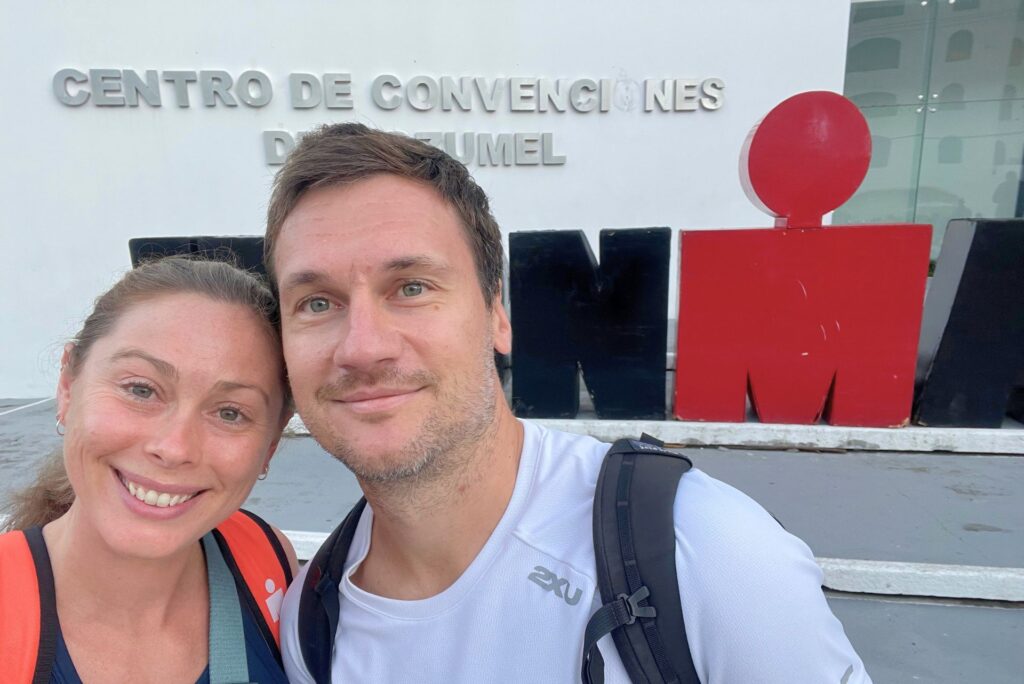
The expo and check-in take place at the Cozumel Convention Centre, right near the finish line. The expo is on the smaller side but still had a decent number of local vendors, and the official Ironman store had a good selection of merch. You could also buy tubes, Co2 canisters, and gels here, although they were a bit pricier than what I’d normally pay at home.
Since we registered so last minute, our names weren’t on any of the merch, so we didn’t spend much time shopping. All I bought was a visor for the run and a few extra gels.
Check-in itself was quick and easy. You show your reservation to enter, then your ID to receive your wristband and packet with your bib number and equipment stickers. After that, you pick up your backpack with all your transition bags inside.
Annoyingly, I made the mistake of not checking the contents of my backpack on the spot — only to get back to our accommodation and discover they had accidentally given me five black personal needs bags and none of the coloured ones I actually needed (blue, red, white, and orange). So I had to go back the next day to sort it out. I also heard they ran out of the orange bags for some athletes, so people had to substitute other colours for their bike personal needs. It worked out, but it wasn’t ideal.
Athlete Briefing
The athlete briefing is offered both in-person and online. The in-person version was held at a host hotel quite far from town, so we opted to watch the online briefing instead — and from what others said, it was essentially the same.
The Day Before: Bag & Bike Drop-Off
In typical us fashion, we ended up preparing our transition bags far too late on Friday night — but everything was ready by Saturday morning.
My partner’s parents were arriving to support us for the weekend, so the plan was to drop everything off before they got there, then spend the afternoon exploring the island together.
Bag & Bike Drop-Off
Just like for athlete check-in, we had pre-booked bike and bag drop-off times, which we tried to stick to — although Ironman didn’t seem strict about enforcing them, as no one checked our reservations.
First, we dropped our run bags off at T2 (near the Mega Supermarket), then headed back to our accommodation to collect the bikes and T1 bags. Normally we would have ridden our bikes to T1 and gotten a taxi back, but we had rented a buggy (a small convertible car) for the day, so we strapped the bikes into the back seat and drove them over instead.
At T1, athletes go through body marking and bike verification (including having photos taken with the bike). Although the number they marked on my arm immediately smudged when I applied sunscreen later (and I noticed plenty of other athletes with the same issue).
T1 is large but well laid out, making it easy to locate your bike — a big difference from my Ottawa experience, where every row looked identical to me. We racked our bikes, hung up our bags, and took a few minutes to familiarise ourselves with the layout before heading back.
We spent the rest of the afternoon driving around the island with my partner’s parents, relaxing at the beach, and grabbing dinner in town… though admittedly a bit later than ideal the night before an Ironman.

Hair Braiding
In the evening, I also got my hair braided by a woman in the main plaza. It wasn’t cheap at around $30 USD, but she did a great job and it held perfectly on race day. If you want the same, you’ll find her near Frida’s Restaurant in Parque Benito Juárez, or you can message her on Facebook: Yolanda Brito.
Ironman Cozumel Race Report
Race Morning
We woke up at 5:00 am on race morning after a few solid hours of sleep – not as much as we would have liked, but it was good enough.
Breakfast was quick and simple (a bowl of cereal) and I made sure to hydrate. I got dressed and ready to leave, including thoroughly applying sunscreen (tip – make sure it’s reef safe!) and chamois butter.
As we weren’t staying with a host hotel, I ordered a taxi to take us to T1, but it didn’t show up. Luckily I was able to immediately flag one down on the street, so we had no issues getting there on time. At T1, we checked our bikes and added our nutrition. From there, Ironman shuttled athletes to the swim start at Chankanaab Park.
Swim (3.8 km / 2.4 miles)
A Long Wait to Start
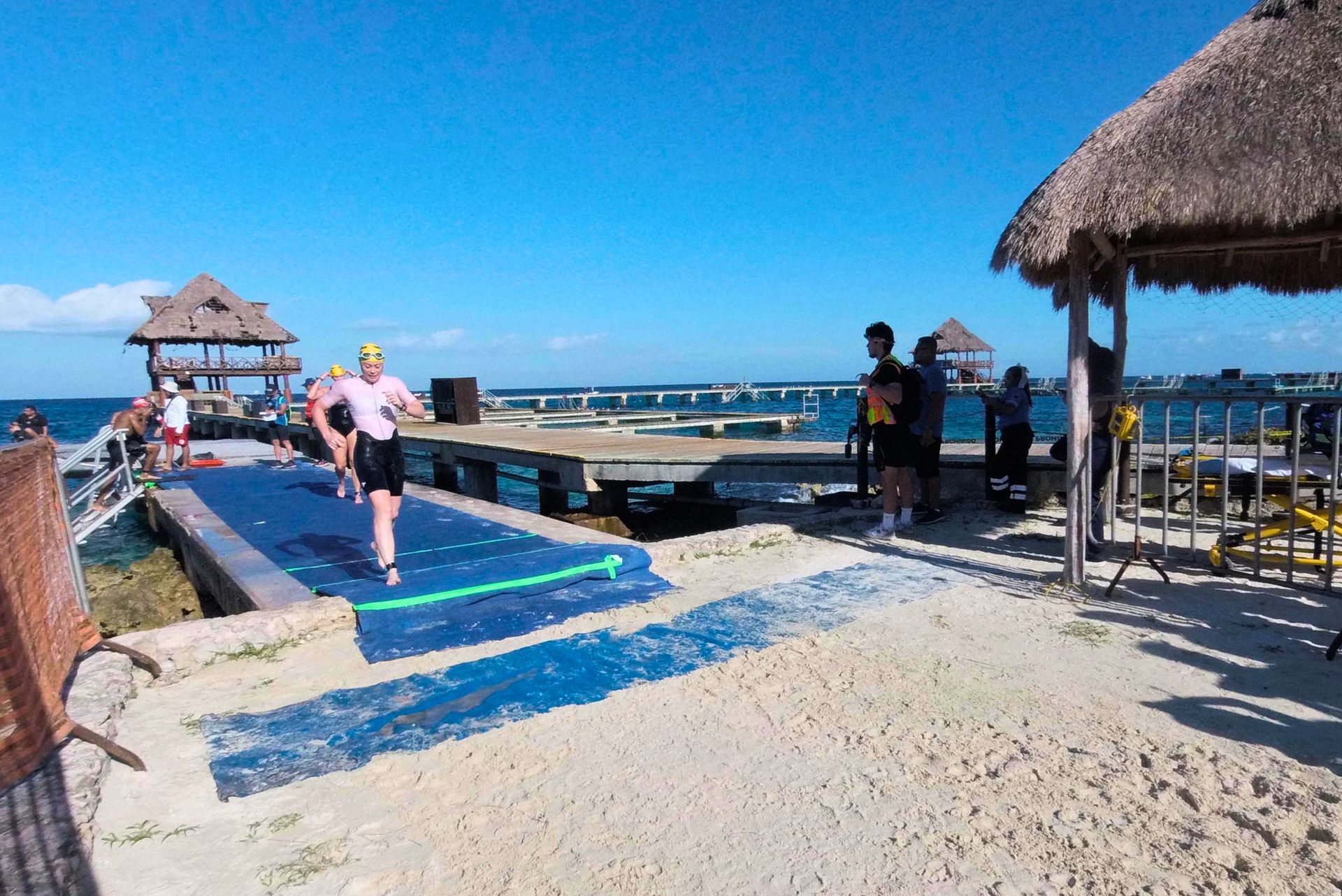
Cozumel has a point-to-point swim, and spectators aren’t allowed at the start, so it was just athletes and volunteers — but there was still a great vibe. What we didn’t anticipate was waiting over an hour to get into the water. The shuttles dropped us off around 6:50 am, the pros started at 7:00 am, and I didn’t get in until 8:15 am. My pre-swim caffeinated gel definitely peaked long before I actually entered the water!
Fortunately, there was a water station with both Gatorade and water right next to the queue, so we could stay hydrated while we waited. We had seeded ourselves in the 1:20–1:30 group based on our Ottawa swim times, but as the line slowly moved forward, I think we accidentally drifted back into the slower group — which delayed our start even more.
Despite the long wait, I felt calm and excited. I never seem to get nervous for the swim; I just treat it as my warm-up for the rest of the day.
The Rolling Start
The swim is a rolling start off a dock. I think the intention was to let four athletes go at a time, but in reality it was more like one or two. My partner and I were lucky enough to start together, and after that I didn’t see him again until the run.
Some athletes slid gently into the water; others jumped. I jumped — covering my face to protect my goggles — and still managed to knock them loose, forcing me to fix them immediately. Unfortunately the goggle issues continued for the first half of the swim, and I stopped to readjust them every few hundred metres. Not ideal, but nothing disastrous.
A Beautiful but Slightly Chaotic Swim
The water was very warm (no wetsuits allowed) and unbelievably clear. Cozumel is famous for having one of the most beautiful Ironman swims in the world, and I immediately understood why: coral reef, colourful fish everywhere, and divers filming us from below.
Although I was enjoying seeing so much on the stunning course, the first half of the swim was quite chaotic. Even though athletes entered the water spaced out, I quickly realised I should have seeded myself farther ahead. I had to overtake a lot of people, which was tricky with the slight chop and the current working against us. Between navigating swimmers, adjusting my goggles, and swimming into a head/side current, my pace was slower than expected — but I settled into a rhythm and kept things comfortable.
Thankfully, the current shifted in our favour for the last 1,000 metres, and I was able to make up time. Despite the slower start, I finished in 1:11:09 — a 15-minute PB from Ottawa!
Was the Course Short?
Something else that likely contributed to my fast swim time was the distance. My watch only recorded around 3,500 metres, and I know several other athletes recorded similar. So it’s very possible the course was a little short. That aside, I still swam at my goal pace and felt strong throughout.
Jellyfish Encounters
The only other challenge was that there were small jellyfish scattered throughout the course. They didn’t bother me too much but I did feel a few light stings and a couple of sharper ones, which all faded within about 30 seconds. And the next day I noticed a few small red bumps that were slightly itchy, but nothing serious.
T1 (Swim to Bike)
I exited the water feeling strong, calm, and excited for the day ahead.
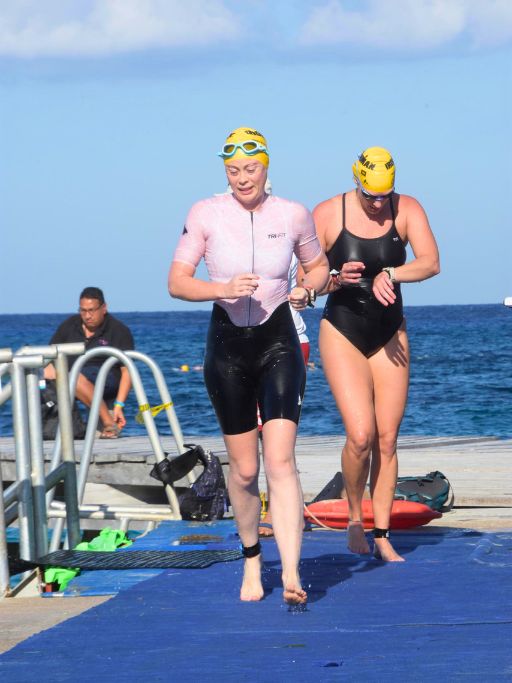
The run from the swim exit to the changing tents is long — around 500 metres — but the path was carpeted, which made it comfortable, and it actually felt good to shake out my legs. They were also handing out water along the way, so we could hydrate as we ran in. Athletes were coming out of the water fairly spaced apart, so transition wasn’t chaotic, but it still had a really upbeat atmosphere.
I rinsed the saltwater off, found my gear bag quickly (a big improvement from Ottawa!), headed into the change tent, and dried off just enough to slap on more sunscreen and get my socks and shoes on. Then I handed my transition bag to a volunteer, grabbed my bike, and headed out.
I found that the mount line wasn’t as clearly marked as Ottawa’s, and there was a slight traffic jam getting onto the bike, but after a few seconds I was able to get on my way. I exited T1 in 7:46.
Bike (180 km / 112 miles)
Cozumel’s bike course circles the island three times: a calm west side, a windy east side, and a short north section before looping back through town.
Tough Conditions
The temperature hovered around 29°C with 65–70% humidity — hot, as expected. But thankfully, cloud cover rolled in on loops two and three (and even a brief rainfall), so I never overheated or got sunburnt. In fact, the temperature was better than I expected, and my two weeks of acclimatisation seemed to pay off.
What really challenged me was the wind.
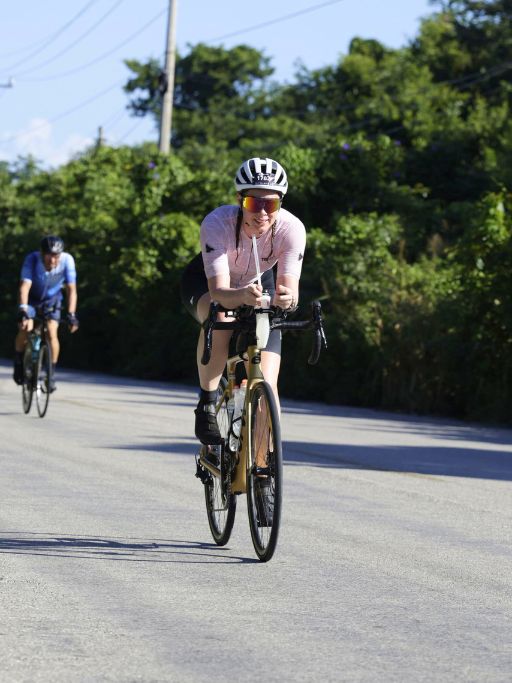
The east side of the island is completely exposed for around 20 km (12 miles), and you get a long, grinding headwind — not just gusts, but a steady wall of resistance. Unlike some courses, there’s no “fast” tailwind section to make up time. You simply lose time battling the wind every loop, with no break.
While I thought I knew what to expect after training along this section, race day was windier than anything we’d experienced beforehand. And every loop got harder as the winds got stronger.
A Challenging and Painful Ride
While the wind was tough, it turned out to be the least of my worries.
A few kilometres into the bike, I developed a deep, intense aching pain in both inner thighs/groin (adductors), as well as some on-and-off pain in my feet. It was bad enough that I had to fight back tears at times.
It worsened in aero, but sitting upright didn’t fix it either. I lifted myself off the saddle frequently, stood up to relieve pressure, and even stopped briefly just to regroup.
Although I’d had foot discomfort while cycling before, this was the first time I’d ever experienced adductor pain like this. I quickly realised it was likely a bike fit issue, and that there wasn’t much I could do during the race.
My fit was probably already a bit off before traveling, as I’d made some adjustments myself — including switching to a new saddle (which did fix the soft tissue issues I had in Ottawa). I was overdue for a professional fit, and after disassembling the bike to travel, I likely didn’t reassemble it exactly the same. It’s also worth noting that I was still using my Cervelo Soloist road bike with clip-on aero bars. It had worked well for me up until now, but was probably never going to be as good as a proper TT bike.
Between the wind and the pain, I simply couldn’t push power the way I normally would, and I knew early that this wasn’t going to be a fast bike split.
Miraculously, by the third loop, the pain eased enough that I could push a little harder — even as the wind picked up. And with the end finally in sight, I was more motivated to keep going.
Nutrition
One thing I did get right on the bike this time was my nutrition. I had recently learned that a blurred-vision issue I often experienced during long efforts was actually an under-fuelling issue, not a sodium imbalance as I originally thought (though electrolytes still played a role).
So I was extremely diligent about fuelling properly. I aimed for ~90 g carbs/hour, taken mostly through liquid nutrition — a lesson learned from Ottawa. I carried a concentrated mix of Tailwind to refill my front-mounted bottle, topping it up with water from aid stations. This worked really well, and I had no trouble drinking it.
I also knew I needed some solids on the bike, so I ate two Maurten bars and one gel (one per loop), plus three salt tabs every hour to stay on top of electrolytes. Overall, I think my hydration ended up at around one litre per hour.
This strategy worked perfectly: no GI issues, no energy crashes, and no vision problems.
Aid Stations
There were five aid stations on course (around every 12.5 km / 7.5 miles). The volunteers were amazing and full of energy, but the aid stations did have a few quirks.
There were volunteers of all ages helping out, which was wonderful, but some of the younger ones got a bit restless later in the day. A few were having water fights during the second half of the bike — fun for them, not so safe for cyclists moving through at speed.
I loved the ice-cold water bottles. I grabbed one at most aid stations to drink and pour down my neck, which felt incredible. But by the last loop, some stations had run out of bottles, forcing athletes to stop and refill. Annoying, but the volunteers worked quickly to move everyone through.
Some stations had Gatorade bottles, bars, and bananas. I didn’t take these, but I noticed the Gatorade bottles didn’t have sports tops, which would have been tricky to manage on the move.

Littering
Unlike Ottawa, Cozumel didn’t have clearly marked litter zones, which made it difficult to know exactly where we were supposed to discard bottles and trash (even though the Ironman rules prohibit littering). To play it safe, I always tossed mine as close to the aid station as possible, where discarded bottles were already collecting.
Unsurprisingly, the lack of signage meant some athletes threw items in places they absolutely shouldn’t have. I even saw someone throw something into a bush, which was extremely disappointing. Cozumel is a beautiful island and home to native wildlife — we really need to do better at respecting and protecting it.
Penalty Boxes
Interestingly, the penalty boxes were the best-marked sections of the entire bike course. They were always positioned just before an aid station, with clear warning signs 500 metres in advance — which, incidentally, became my cue to prepare for bottle exchange.
However, one penalty box was located directly in front of the bike finish chute, which confused me during the first loop. I wasn’t sure whether it marked the end of the course or was simply another penalty area. On my second loop I made a point to pay closer attention, just so I knew exactly where to go on my final lap.
Personally, I would have thought clearly marking the finish line was a higher priority than marking the penalty boxes.
Drafting
Something else that was disappointing to see was the amount of drafting — and not just among the front packs. Plenty of slower athletes were drafting too, especially on the windy section of the course. Large groups formed on every loop.
To be fair, the conditions made it difficult. On the windy side, everyone was just trying to survive, and it was sometimes unavoidable.
Personally, I always try to do the right thing, and on the windy stretch I would usually slow down to avoid getting too close to others. I had just accepted that this section was going to be slow. But by the last loop, it became more and more difficult to avoid getting absorbed into packs. Surging past wasn’t always possible, and more athletes began blocking by riding in the middle of the road.
But the biggest offenders were the fast packs — huge groups of age-group leaders riding wheel-to-wheel with seemingly no concern for the rules. It was frustrating, especially knowing these athletes were racing for podium spots or Kona slots. Hopefully next year marshals enforce the rules more consistently early in the day.
Final Thoughts on the Bike
The bike was really hard, and until the last loop, I genuinely wasn’t enjoying it because of the pain. But that was an issue with me, not the Cozumel course.
Overall, I really liked the bike course. It’s not the most scenic — most of it is forested road with limited views except on the east side (and the wind there definitely distracts you from the scenery!) — but the road conditions are excellent. Smooth surfaces, few bumps, and, aside from the headwind, an undeniably fast and flat layout.
I’d love to come back again with more training and a better bike setup to properly race this course.
I finally rolled into T2 sore, relieved, and excited to start running. My final bike time was 6:34:01 — much slower than I was aiming for, but I’m really proud that I pushed through and didn’t give up.

T2 (Bike to Run)
I was in and out of T2 in 6 minutes flat — although I’m not entirely sure what I spent a full six minutes doing. The transition area is quite small, so there really isn’t far to go. My legs felt like jelly at first, so I was probably just moving slower than I realised.
I stopped in the change tent to put on my running shoes and socks, slapped on a bit more sunscreen, grabbed my gels and salt tabs, and headed out onto the run course.
Run (42.2 km / 26.2 miles)
Cozumel’s run course is a three-lap out-and-back along the road north of the airport. Like the bike, it’s not particularly scenic, but what it lacks in views it makes up for in atmosphere. There are spectators almost everywhere, and the stretch through town is incredible — huge crowds, music, and enough energy to make you feel like the whole island is cheering you on.
By the time I started the run, the sun was out again. But after two weeks of heat acclimatization, the 29°C temperature and humidity felt surprisingly manageable, and I knew we only had a couple more hours of sun to get through.
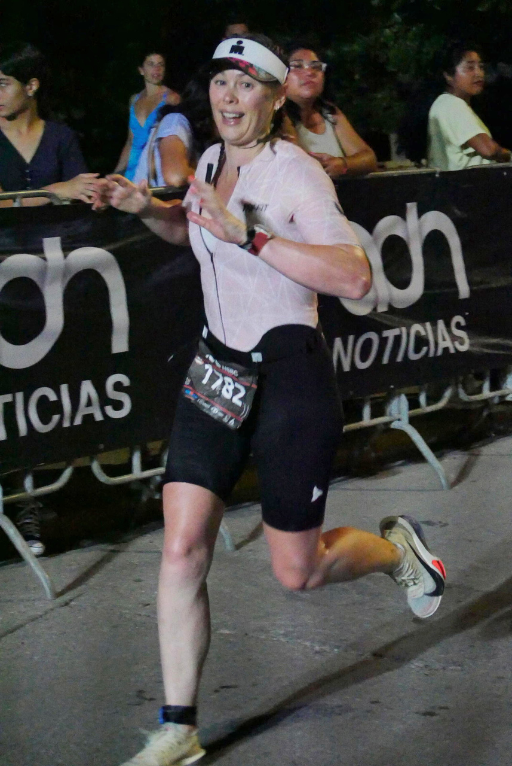
I quickly found my legs and settled into a comfortable pace. My plan was always to walk the aid stations, as this strategy had worked really well for me before. With stations every ~1 km, I probably walked a bit more frequently than ideal — but I definitely appreciated the regular breaks.
Aid Stations & Nutrition
The aid stations were excellent and consistent. Most had water, ice, Pepsi, and salty snacks like pretzels or peanuts. Many also had bananas, orange slices, and muesli bars. Although the only place on course with gels was right after the turnaround at the end of each lap, where volunteers were handing out Maurten gels.
Something I hadn’t experienced before was that the water came in bags — you bite the corner off to drink — which worked brilliantly for running. I didn’t end up using much ice, but I grabbed a water bag at nearly every station to drink from and pour over myself.
My main fuelling on the run was Pepsi (a small cup at most stations), one banana halfway through, and the nutrition I carried. From memory, I took around five gels and about twelve salt tabs.
Littering
Like on the bike course, there were no clearly marked litter zones on the run. I knew discarding trash should be done at the aid stations, so I always aimed to toss mine into a bin or onto an existing pile of rubbish near the volunteers. But not everyone did this, and the course quickly became strewn with water bags and gel wrappers.
I did see volunteers cleaning up between stations, and by the next day the run course was spotless. But it would be great to have more clearly defined litter zones, and even without proper signage, we as athletes need to do a better job of following the rules and respecting the island.
Pacing
I would have loved to go sub-12 in this race, but after the slow bike split I let that go and focused instead on beating my Ottawa time, which was still very achievable.
I held a solid pace on lap one and slowed slightly on lap two. I also lost a few minutes with my one porta-potty stop of the day (and the battle to get back into my trisuit afterward).
At the halfway point, I caught up with my partner who was running a steady pace, and I decided to stick with him despite slowing down a bit. I was still well on track for a PB, and I liked the idea of running part of the marathon together.
But halfway through the final lap, I realized my watch had auto-paused during my bathroom stop, so I had almost five fewer minutes than I thought. Suddenly, getting a PB became a lot harder — but not impossible.
Push to The Finish Line
At the turnaround, I left my partner and launched into my fastest running of the entire day. For the final 7 km, I ran threshold pace from aid station to aid station — quite a tough thing to do 12 hours into an Ironman — stopping only long enough for a splash of water and a shot of Pepsi.
Because I wasn’t completely sure how much time I had left, I just kept accelerating. I wasn’t taking any chances.
The only hiccup came about 3 km from the finish, when a drunk spectator decided to “race” me — running beside me, looking at me for a reaction, and then cutting me off twice, forcing me to stop. I was furious in the moment and quite confused by what was happening, but I dropped him quickly and got back into my groove.
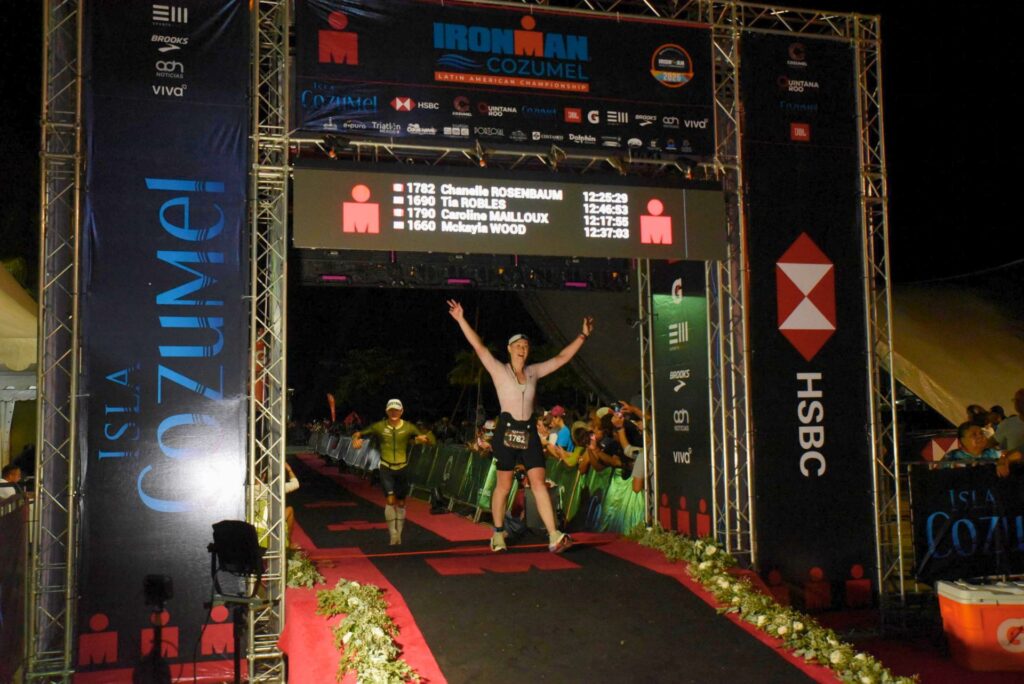
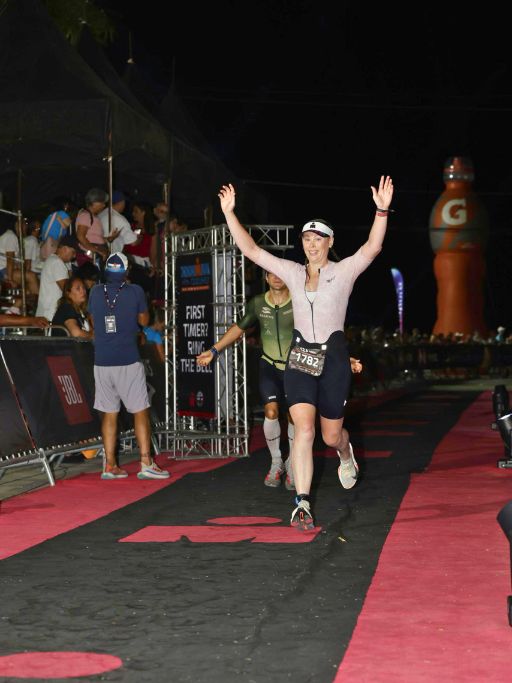
Despite the chaos, that final push was my favourite part of the race. I felt fast, strong, and determined, overtaking athlete after athlete and sprinting down the finisher chute.
I finished the marathon in 4:26:32 and crossed the line in 12:25:29 with a two-minute PB!
Post-Race
The volunteers at the finish line were wonderful. One of them walked with me to make sure I was okay, placed my medal around my neck, and guided me toward the food and recovery area.
Finish-line Food & Recovery
The finish-line food at Ironman Cozumel wasn’t great — cold pizza slices, bananas, instant noodles, and assorted drinks (Gatorade, sodas, and water). I grabbed a slice of pizza and a banana, then sat down and chatted with another athlete until my partner’s parents found me.
While the food was disappointing, the recovery setup was excellent. They had big cold tubs (which I was tempted to use but skipped) and massage therapists offering a mix of stretching and massage. I got about 20 minutes with them, and it was exactly what I needed.
One thing missing, however, was a proper change area. I wanted to get out of my wet clothes while waiting for my partner to finish, but with no designated changing space, I ended up awkwardly changing in a corner of the old T2 tent that had already been partially taken down.
Dinner
Once my partner finished, we met at the chute, cheered for a while, took photos, and soaked up the finish-line atmosphere. By the time we were both ready for real food, it was 11 p.m. — and every nearby restaurant had stopped serving. So our celebratory meal ended up being snacks from 7-Eleven. Not glamorous, but it did the job.
The Next Day
The next day was pure recovery mode. We spent it at a beach club swimming, snorkelling, relaxing in the shade, and enjoying plenty of food and non-alcoholic cocktails. Surprisingly, I felt much better than after Ottawa — still sore, of course, but far more mobile, energized, and much less wrecked overall.
Final Thoughts — Ironman Cozumel Race Report
Ironman Cozumel wasn’t perfect. My bike was much slower than I’d hoped, but despite that, I managed to improve every other discipline and still walk away with a PB — something that felt like a huge win given how spontaneous this race was and how imperfect my training had been.
I know I had more to give, but I’m proud of how I managed the pain on the bike, refused to give up, and pushed myself harder than ever in the final 7 km of the run. There were highs and lows, but overall it was a fantastic race in a beautiful setting, and Cozumel absolutely lived up to its bucket-list reputation.
Hopefully my Ironman Cozumel race report has inspired you to sign up for this race or at least given you a clear idea of what to expect on the day. If you have any questions about the course, logistics, or my experience, feel free to leave a comment below — I’m always happy to help!